
Ask "who is the electric doorbell inventor" and you get three honest answers, each about 80 years apart. Joseph Henry rang the first electric bell over a wire in 1831. Robert S. Edwards patented the electric doorbell as a product you could buy in 1881. And in 2011, Jamie Siminoff bolted a camera and a Wi-Fi chip onto that same century-old idea, called it DoorBot, got rejected on Shark Tank, and sold it to Amazon as Ring for about a billion dollars. This post walks the whole line, from Henry's lab bell to the Ring on your porch.
Before Electricity: How People Announced Themselves at the Door
The doorbell problem is older than electricity. For centuries the answer was a door knocker — a hinged metal ring you banged against a plate. It worked at the door and nowhere else. If you were three rooms away, you never heard it.
Big 19th-century houses solved the range problem with servants' bells: a pull at the front door tugged a system of wires and pulleys that rang a bell in the servants' quarters. It's the first real attempt to move the signal away from the door and put it where the person who needed to answer actually was — the exact problem Siminoff would solve again 200 years later, just with your phone instead of a footman.
There was even an early mechanical shortcut. In 1817 the Scottish engineer William Murdoch rigged a compressed-air system in his own home that could ring a bell from a distance. Clever, but fiddly. The idea that finally stuck needed electricity.
Who Invented the Electric Doorbell
Before anyone put a doorbell on a phone, someone had to make a bell ring over a wire. The electric doorbell is older than most people assume, and its history runs through two names worth knowing: Joseph Henry and Robert Edwards.
Joseph Henry and the First Electric Bell (1831)
The direct ancestor of the electric doorbell is an experiment the American scientist Joseph Henry ran at the Albany Academy in 1831. Henry strung a wire across the room, wound a powerful electromagnet by tightly coiling insulated wire around an iron core, and used a battery to close a circuit that pulled a small lever and struck a bell at the far end.
He wasn't trying to build a doorbell. He was showing his students that an electrical signal could travel down a wire — in one demonstration, through a mile of copper — and do mechanical work at the other end. That single idea, a switch on one end and a bell on the other, is the whole principle a doorbell runs on, and it fed straight into the telegraph and the telephone that followed. Henry later became the first secretary of the Smithsonian.
Robert Edwards and the Electric Doorbell Patent (1881)
Henry proved the concept, but the person most often named as the electric doorbell inventor is Robert S. Edwards. In 1872 he founded Edwards & Company in Norwalk, Connecticut, with partner David Rousseau, first to make battery-operated igniters for gas fixtures. In 1873 Rousseau left, Adam Lungen joined, and the pair developed an electric doorbell and a burglar alarm.
Robert Edwards received his first patent for an electric bell in 1881 — the moment the electric doorbell moves from a lab demonstration to a product a household could buy. His design ran on a battery-powered circuit, which mattered: most homes in 1881 had no wired electricity yet, so a self-contained battery bell could work anywhere.
Edwards didn't stop at the bell. His patents over the next few years read like a catalog of the whole signaling business he was building:
- 1881 — electric bell (his first patent)
- 1882 — drop-type annunciator (the board that showed which room was ringing)
- 1883 — push-button electric gas lighter
- 1884 — electric door opener
In 1884 he showed his products at the first U.S. electrical exhibition in Philadelphia. The company he built became Edwards Signaling, still a name in fire-alarm and life-safety hardware today, nearly 145 years on.
So there are two honest answers to "who invented the electric doorbell." Joseph Henry built the first electric bell in 1831 and proved the principle. Robert Edwards patented the electric doorbell as a commercial product in 1881. One is the science; the other is the doorbell you'd recognize on a front porch.
A Century of the Same Circuit
Here's the quiet part of the story: after Edwards, the doorbell barely changed for a hundred years. The wired chime that sat next to millions of front doors ran on the same low-voltage circuit — a transformer stepped household power down to a safe 6 to 24 volts, a button closed the circuit, a chime rang. Wireless doorbells arrived mid-century using radio instead of a wire, but the job was identical. Push button, bell rings, done.
What Jamie Siminoff added in 2011 wasn't the bell. It was the answer. His DoorBot kept the century-old idea of a signal at the door and added a camera, a Wi-Fi chip, and your phone, so the person ringing and the person answering no longer had to be in the same building. The line from Henry's 1831 bell to the Ring on your porch is one long argument about the same question: how do you know someone's at the door, and how do you respond?
The Ring Doorbell Inventor: Jamie Siminoff
The man behind the Ring doorbell is Jamie Siminoff, a lifelong inventor who built the world's first Wi-Fi video doorbell in his garage. His story didn't start with a grand vision for home security. It started with a simple problem: he kept missing deliveries because he couldn't hear the doorbell.
Back in 2011, Siminoff was tinkering in his garage in Santa Monica, California, and grew tired of finding "Sorry we missed you!" slips on his door. He wanted a way to answer the door even when he wasn't near it, so he connected his doorbell to his smartphone. That was the genesis of DoorBot, the original Wi-Fi video doorbell prototype.
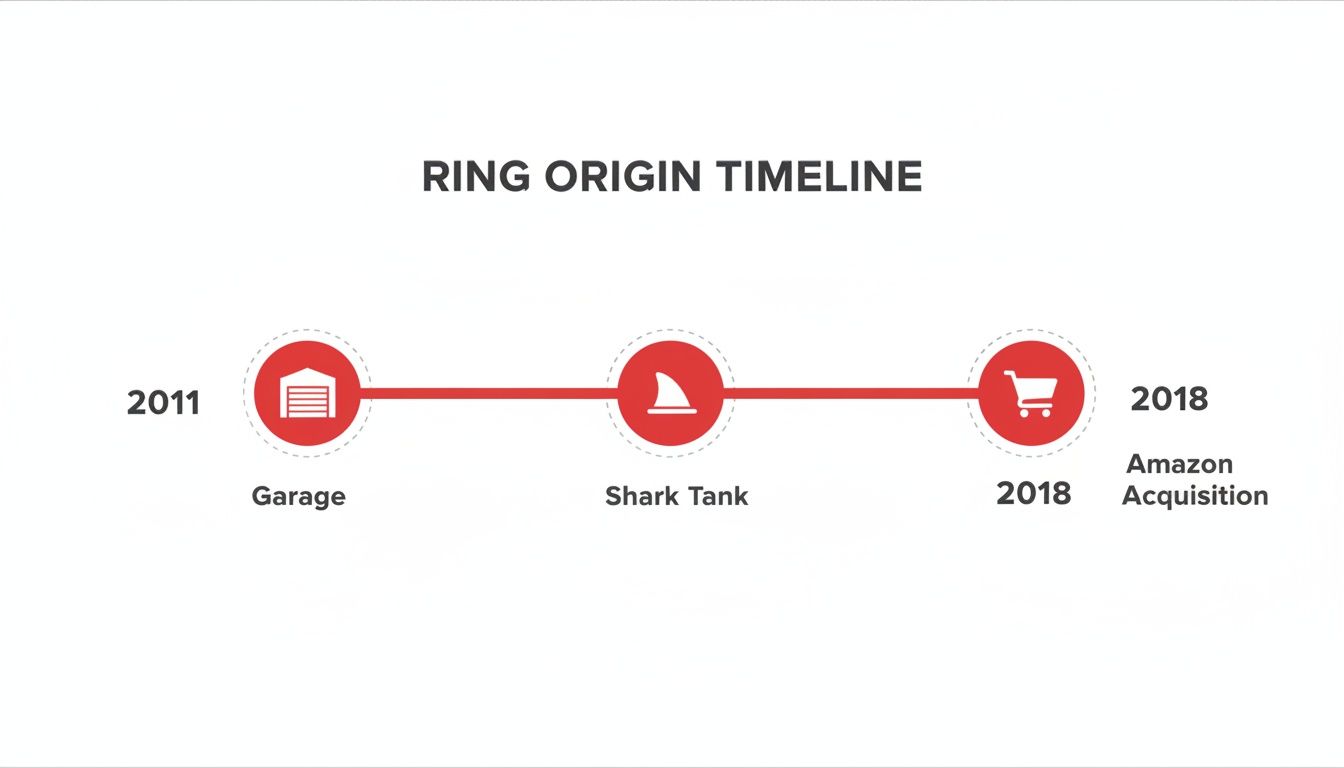
Jamie Siminoff's Journey at a Glance
The table below outlines the critical moments in Siminoff's path from a frustrated tinkerer to a home-security founder.
| Milestone | Year | Significance |
|---|---|---|
| Initial Idea | 2011 | Siminoff builds the first Wi-Fi video doorbell, DoorBot, in his garage to solve a personal problem. |
| Shark Tank Appearance | 2013 | Rejected by the investors, but the exposure generated huge public interest and sales. |
| Rebranded to Ring | 2014 | The company rebrands from DoorBot to Ring, reflecting a broader mission of neighborhood security. |
| Series B Funding | 2015 | Secures $28 million from investors including Richard Branson. |
| Amazon Acquisition | 2018 | Amazon acquires Ring for a reported $1 billion, cementing its place in the smart-home market. |
His story is a practical approach to innovation. He wasn't chasing abstract tech trends; he was chasing a fundamental human need. As he put it:
"I tend not to think in terms of, 'in X years, we're going to build this.' Instead, I try to think about finite truths. For example, I know people want to feel like they're always home, so I'm going to focus on that."
Building the First DoorBot From a Simple Idea
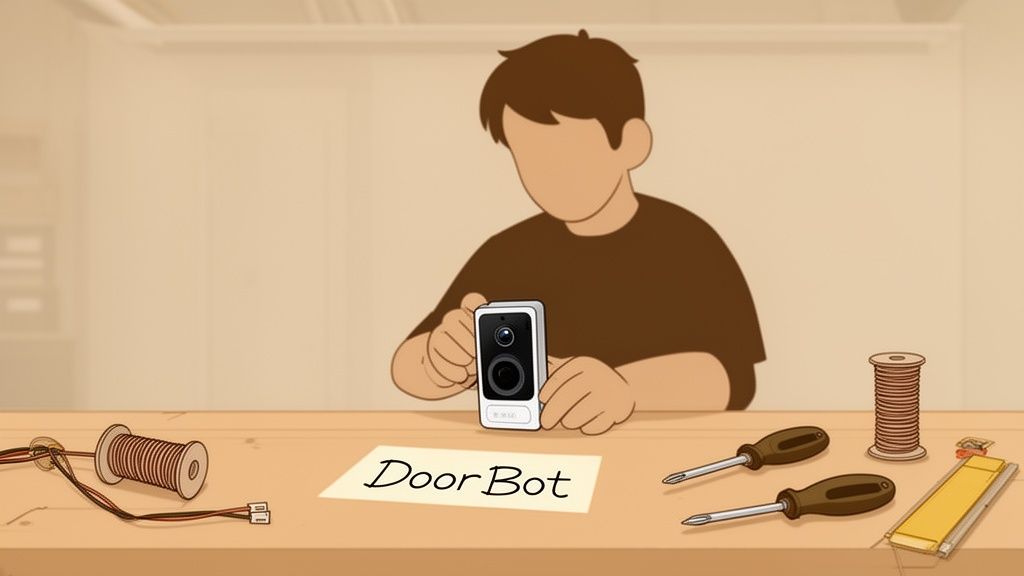 Siminoff, a lifelong tinkerer, hacked together spare parts, a Wi-Fi chip, and a camera to create a device that let him see and speak to whoever was at his door, right from his smartphone. This was the birth of the world's first video doorbell, which he called DoorBot.
The tech was there, but the idea needed a hook anyone could understand. That's where his wife, Erin, came in.
She called it "caller ID for your front door." That one phrase was all it took. Suddenly everyone got it. It wasn't a gadget for techies; it was a practical tool for everyday life.
An Inventor's Foundation
DoorBot wasn't Siminoff's first swing at building a company. He had a history of other ventures, and while they weren't all runaway successes, they gave him a real education in what it takes to launch a product. That background of trial and error is what prepared him for the journey ahead. His story is a plain example of what innovation in business actually looks like: not one flash of brilliance, but persistence and learning from mistakes.
Turning a Shark Tank Rejection Into a Launchpad
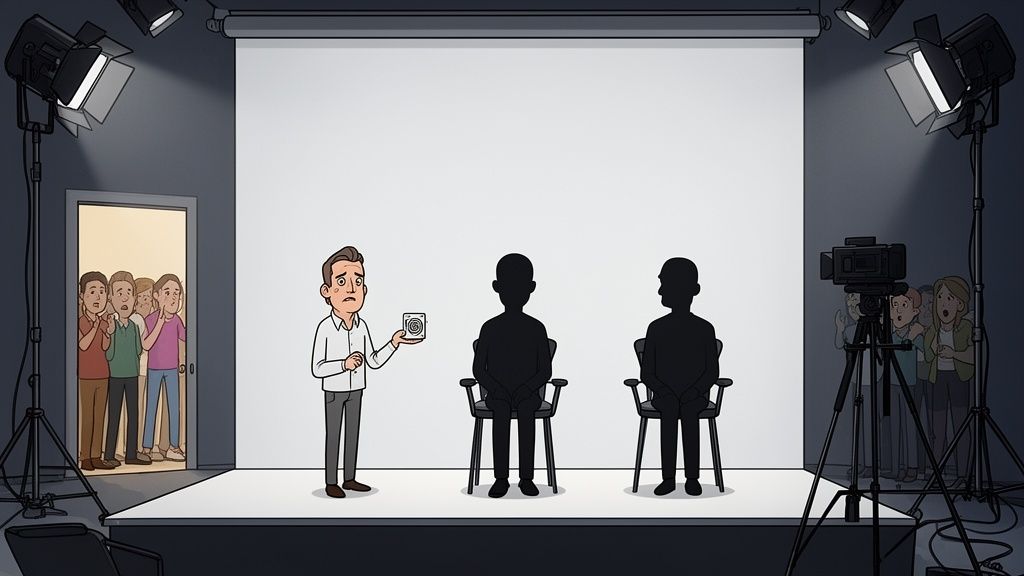 Pitching your passion project on national TV and getting shot down sounds like a nightmare. In 2013, that was the reality for Jamie Siminoff when he appeared on Shark Tank in Season 5, Episode 10. The product, then known as DoorBot, met a healthy dose of doubt.
Siminoff walked onto that set and made his ask: $700,000 for a 10% stake, valuing the company at $7 million. Most of the Sharks, including Mark Cuban, weren't buying it. Kevin O'Leary was the only one to make an offer, but it was a messy deal involving a loan and a royalty that undervalued what Siminoff was building. He turned it down and walked away empty-handed.
Search "doorbot ring shark tank blog" today and you'll find dozens of retellings, because the twist is that good. For most people, that kind of public failure would be crushing. For Siminoff, it turned out to be the best thing that ever happened to his company.
The Rejection That Sparked a Movement
The moment the episode aired, everything changed. The Shark Tank exposure did something paid advertising never could. Millions of viewers didn't see a flawed product; they saw a brilliant idea — caller ID for your front door.
This supposed "failure" put DoorBot on the map overnight. It created a surge in demand that proved the product's real-world appeal. Sales went through the roof, showing just how wrong the Sharks had been.
Siminoff's story is the ultimate lesson in turning a "no" into fuel, which is exactly why so many companies bring in keynote speakers on entrepreneurship to inspire their own teams. He also got the last word: in 2018, the same year Amazon bought Ring, Siminoff returned to Shark Tank as a guest investor, sitting in the chair opposite the founders who had once passed on him.
How Ring Proved Its Mission to Make Neighborhoods Safer
After getting turned down, Siminoff walked away with new clarity. He rebranded DoorBot to Ring, a name that captured a bigger vision: a "ring of security" around every home. That mission caught the attention of investors like Richard Branson and Shaquille O'Neal, who saw the potential the Sharks had missed.
The LAPD Pilot Program
To prove the idea wasn't just a slogan, Siminoff needed data. In 2015 he launched a pilot program with the Los Angeles Police Department: install Ring devices in one neighborhood and track what happened to local crime.
The study found that installing Ring devices in just 10% of homes in a neighborhood was linked to a 55% drop in home break-ins. It was an early sign of the network effect: a small number of devices could shift outcomes for the whole street.
The LAPD program gave Ring evidence to shift from a smart-home novelty to a community-safety tool, and it set up the growth that followed.
The Billion-Dollar Amazon Acquisition
 By 2018, Ring wasn't just another gadget; it was a household name. That year Amazon acquired Ring, a move that confirmed the smart-home market was here to stay. For Amazon, the deal made the company a major player in home security overnight and let it weave Ring into the Alexa ecosystem, right on its customers' front porches.
Ring's sale to Amazon, reported at $1 billion to $1.2 billion, was a landmark tech acquisition. It validated Siminoff's vision and crowned him the inventor who built a home-security business from a single, simple idea.
It was a full-circle moment for the ring doorbell inventor: a story that started with a personal frustration, weathered a famous TV rejection, and ended with a billion-dollar deal that redefined an industry. As of 2026, Siminoff is still building — he returned to lead Ring after a stint away, now pushing the product toward AI.
Why Siminoff's Story Resonates With Today's Leaders
There's a reason leaders keep coming back to Jamie Siminoff's story. It's a roadmap for navigating modern business, filled with practical lessons for anyone leading a team. The pattern carries beyond Siminoff. Chris Barton, who built Shazam after MIT and Stanford experts called the underlying pattern-recognition impossible, has the same archetype: a non-technical founder-turned-inventor who shipped a product used by billions. Adam Cheyer, co-creator of Siri (now on 2B+ Apple devices), is another point on the same curve. We represent both as keynote speakers for innovation and entrepreneurship events.
Core Lessons for Modern Teams
- Embracing public failure: Getting rejected on Shark Tank could have ended things. Instead Siminoff used it as a marketing opportunity and turned the setback into fuel.
- Holding a clear mission: The switch from "DoorBot" to "Ring" wasn't cosmetic. He stopped selling a gadget and started selling a mission to make neighborhoods safer, and that is what rallies a team and keeps customers loyal.
This is the kind of high-stakes story that wakes up a room, which is why he's such a sought-after voice for events. If you're looking for that kind of impact, our guide to finding the perfect leadership keynote speaker can help you spot what makes a story like his land.
Frequently Asked Questions About the Doorbell Inventor
Who invented the electric doorbell?
The first electric bell was built by American scientist Joseph Henry in 1831, who used an electromagnet and a battery to ring a bell over a wire. The electric doorbell as a patented, commercial product is credited to Robert S. Edwards of Edwards & Company, who received his first patent for an electric bell in 1881. The modern Wi-Fi video doorbell, the Ring, was invented by Jamie Siminoff in 2011.
When was the electric doorbell invented?
It depends which milestone you count. Joseph Henry built the first working electric bell in 1831. Robert Edwards patented the electric doorbell as a commercial product in 1881. So the science is 1831 and the product is 1881, roughly a 50-year gap between the demonstration and the doorbell you could actually buy.
Is Edwards the electric doorbell inventor?
Robert S. Edwards is the name most often given as the electric doorbell inventor. He founded Edwards & Company in 1872 in Norwalk, Connecticut, developed an electric doorbell and burglar alarm with his partner Adam Lungen, and patented an electric bell in 1881. He went on to patent an annunciator (1882), a push-button gas lighter (1883), and an electric door opener (1884). His company later became Edwards Signaling. Joseph Henry built the earlier 1831 electric bell that made the doorbell possible.
Did the Ring doorbell inventor get a deal on Shark Tank?
No. Jamie Siminoff walked away from Shark Tank empty-handed in 2013. His invention was called DoorBot at the time, and while four sharks passed, Kevin O'Leary made an offer that Siminoff turned down, convinced it undervalued the company. The national exposure from the show then created a huge spike in sales, and in 2018 Siminoff returned to the show as a guest investor.
How much did Amazon buy Ring for?
In 2018, Amazon acquired Ring for a reported sum of over $1 billion (widely put at $1 billion to $1.2 billion). The exact number was never made public, but it was one of Amazon's largest acquisitions and a clear signal about the future of the smart home.
What was the Ring doorbell originally called?
Before it was Ring, the video doorbell was DoorBot. Siminoff rebranded the company to capture a larger vision: a "ring of security" around the entire home, not just the front door.
Is Jamie Siminoff still at Ring?
Yes. Siminoff stayed on after the Amazon acquisition and, as of 2026, is leading Ring again after a period away, steering the product toward AI-driven features.
Related: Innovation keynote speakers, Innovation in business, Inspirational business speakers
Jamie Siminoff's journey from a garage tinkerer to a billion-dollar founder is exactly the kind of story Silicon Valley Speakers brings to corporate audiences. Connect with our team to book a speaker who can inspire your people with real-world tales of building the future.